Yara Abu Aataya is a Palestinian-born, Czech-raised artist and designer. She’s an old contact of mine and we often crossed paths in Prague’s local techno scene, as she was involved in the production side of things during the vibrant underground movement of the 2010s. We reconnected at one of her design exhibitions in September of last year and promised to catch up shortly after. A few weeks later, tragic events would begin to unfold in her birthplace of Gaza, adding a whole new layer to our conversation.
Seven months later, the situation in Gaza has deteriorated beyond what anyone thought possible. While initially reluctant to be overtly political, she now finds herself at the forefront of protest efforts in a traditionally pro-Israel Czech context.
Besides speaking with the media and fundraising, she has also been involved with a collective of artists in Prague called Stop Genocide in Gaza. The group’s main goal is to voice an alternative perspective to the mainstream Czech media’s approach to the conflict. They organised a guerilla protest at the National Gallery in Prague’s spring season opening in late March, in which they dumped flyers from the upper floors as Yara seized the microphone onstage.
The main motivation was frustration at the fact that after the usual run of interviews and talks, little help or attention was being paid to the Gaza issue. “Business as usual” had to be disrupted, especially at the National Gallery where many members of the collective were exhibiting. This hypocrisy was further compounded by the fact that the exhibition was called “Collection of Solidarity for Skopje in Macedonia” Furthermore, the director of the National Gallery, Alicja Knast, commented on her plans for 2024: “From my point of view, we will have to find new ways to discuss and deal with the colonial past, including in the countries of Central Europe.”
Yet, still silence on Gaza.
As Yara took the stage, a striking irony was created. In the same venue where she was able to share so much of her story through her design work, speaking with curious visitors who praised and listened to her story, she was now being silenced for speaking up against the brutal systematic killing of Palestinians.
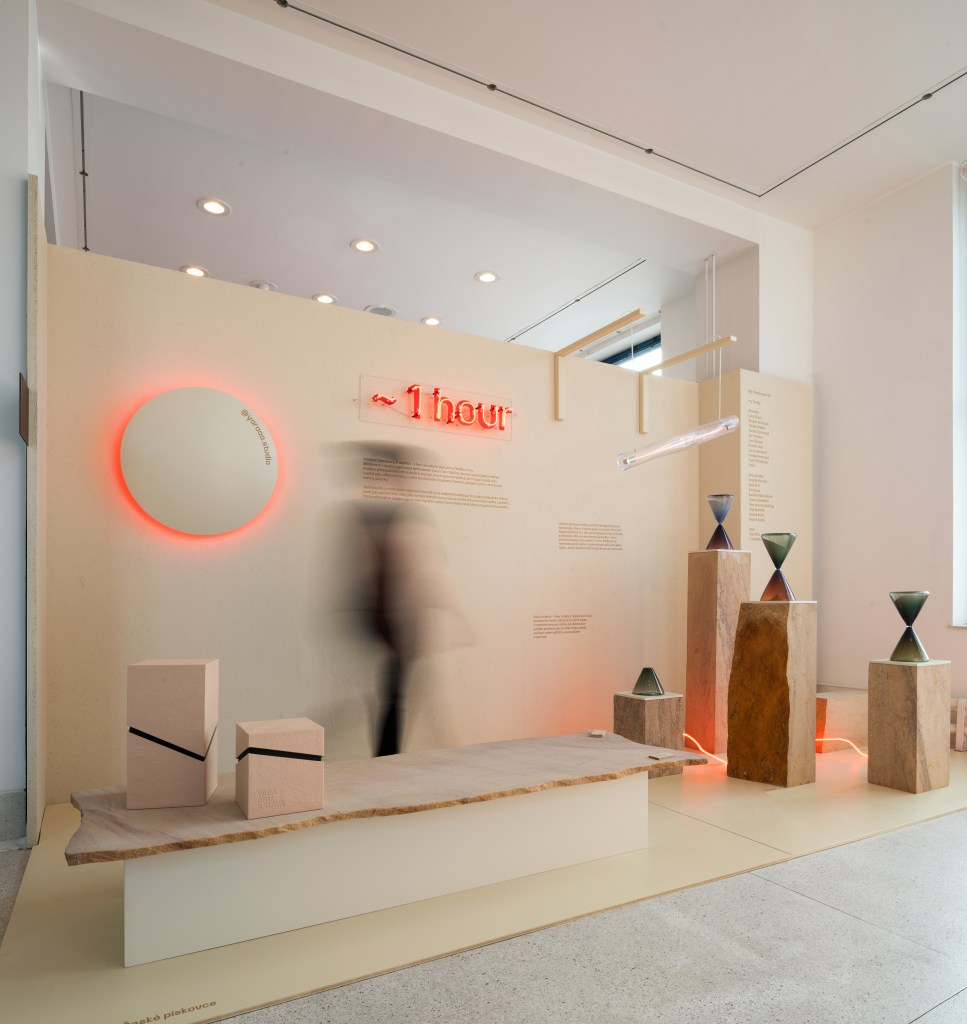
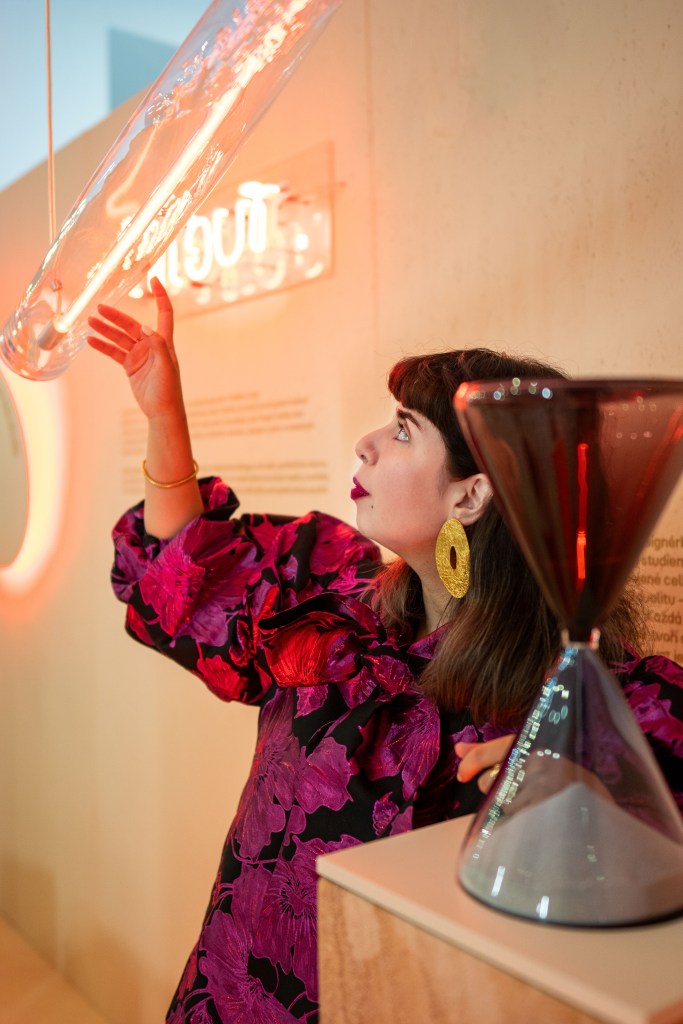
This work was directly inspired by her Arabic roots, blending imagery of desert sands and contemporary glass work to create a unique set of hourglasses. While her work on these hourglasses has been celebrated since, the narratives she represented have been largely ignored by the Czech media. The Czech government is also historically pro-Israel, with President Petr Pavel even visiting Benjamin Netanyahu on a ‘friendly visit’ in January.
In the face of such opposition, Yara continues to share the Palestinian side of the story as much as she can – through her online and offline activism, media presence and protest art (she is also organising a public event later this week – Light For Palestine) . Given her background in the techno scene, famous clubs such as Ankali and Fuchs 2 have also shown support for the Palestinian cause. Clubbing has always had roots in social protest, being a historical safe haven for marginalised communities. When the mainstream media fails, so it has been left to a thriving and tight-knight subculture of artists, clubs and their networks to build solidarity.
The following is a transcript of the conversation I had with Yara in December, 2023. You can listen to the full episode wherever you get podcasts.
K: Today, I wanted to upload this little conversation I had with a friend who happens to be Palestinian-Czech. She’s a designer and architect. We crossed paths at a design convention recently and reconnected. With the recent news, I thought it’d be worth getting to know her a little bit and hearing her story, finding out what it’s like to be a Palestinian artist living in Central Eastern Europe.
[Yara] was born in Gaza, has grown up in Prague her whole life, and in the past month, since October 7, she’s been featured in many news media outlets in the Czech Republic. If you don’t know, Czech Republic is currently under a fairly pro-NATO, pro-West government, and historically and traditionally tends to be fairly pro Israeli here. So Yara has faced a lot of mixed feelings about being Czech Palestinian, and her profile in the media.
We start the conversation with her reminiscing about her early student projects, and how she got involved in the local techno scene as both a party-goer and part of the production teams.
Y: … I loved the way people met from different subcultures and they sometimes even became friends. But the mix was the inspiration for me. It had different dynamics. Well, but I felt that it was not wanted in Prague [in those days], so we didn’t continue with [early collab project] Škatule. We did like seven or eight events. And then I went for one year to Japan. And after I came back, I continued doing Tetris, while I was also studying architecture at Umprum.
So I was thinking of doing something with light and installations. And we did this light group called NYX like, and we did several events and it was very nice that we tried and we experimented a lot because we didn’t have much money, so we tried to make a lot with no money.
So, yeah, basically, that was my beginning with NYX. I remember trying a lot of experimental work, even in places which are now very popular, like Fuchs, which was called Face2Face Club.
K: I remember that. Yeah.
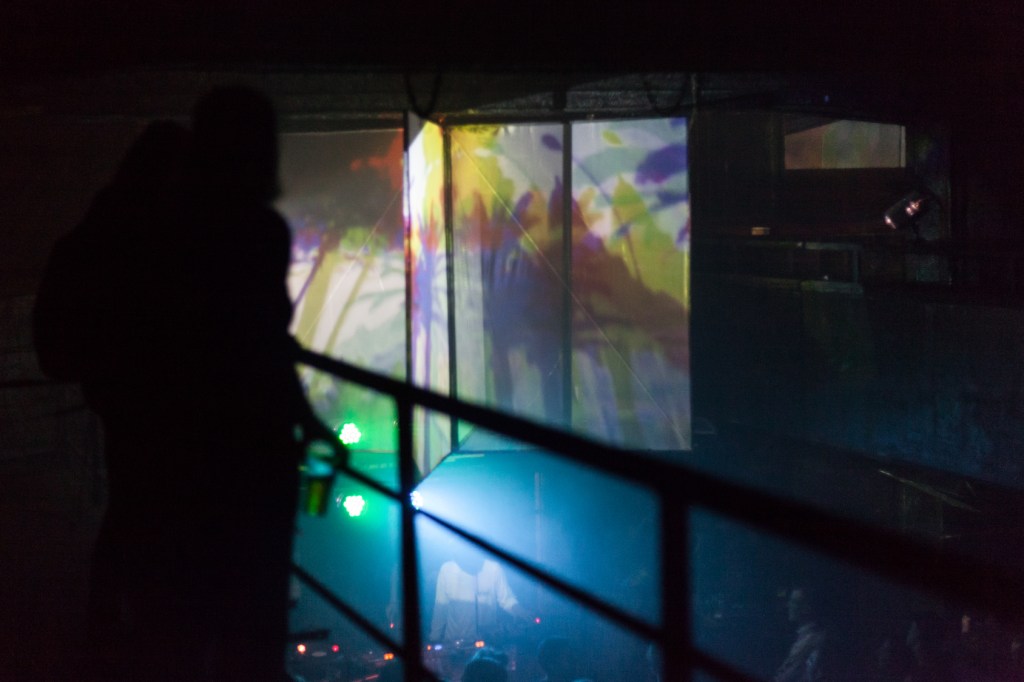
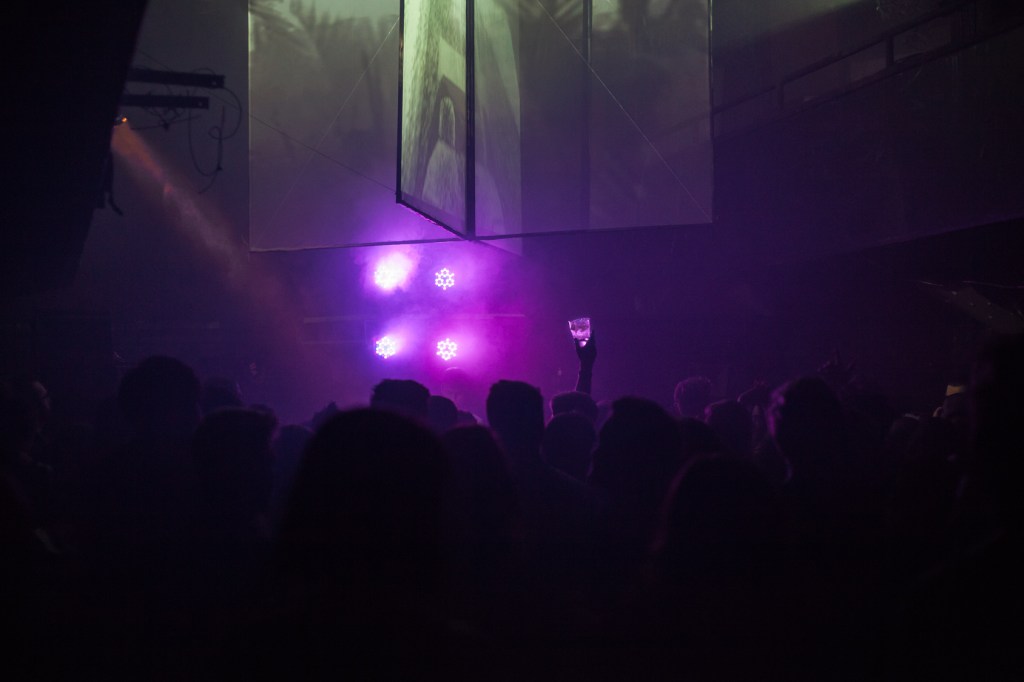
Y: And there were no cables, no electricity, and we had to put it all together ourselves. Which took two days to put it all together. And we had to make sure that even during the party, it wouldn’t die.. And we did a huge object with mesh, and were projecting through it, but it was all hanging on plastic stuff, so we were very scared it would all fall. But somehow, Fuchs is a very stable building, let’s say somehow, even though it doesn’t look like it is!
K: And then it became Fuchs, what, four or five years ago now? Or longer?
Y: I’m not sure. I would not say longer. No. Five, six.
K: So you were really the pioneering group breaking ground for this new scene that’s quite active now!
Y: I would say that the first people who started that kind of electronic music scene were Polygon, and then they kind of merged into Lunchmeat, and then even to Signal Festival. Even with Ankali. It’s a small scene, so they’re kind of spread all over the place.
But the Polygon events. I just hold very nice memories there because it was the very beginnings, People felt, I would say, more hidden. It was more personal, somehow.
K: And so are you still involved with Tetris or this scene at all?
Y: Not much, actually. I just sometimes help you with the scene. Sometimes they need help with the lighting, but just like on that day, not with the creative part.
K: Right. Because now you’re focusing more on your design work.
Y: Yeah, but at the same time, I have, like, eight completely different projects every month!
K: At UMPRUM, did you major in design or in architecture?
Y: Actually six years of architecture, but I was also doing type design for a semester, and then I stayed in the graphic scene so I was doing bookbinding workshops and lithography and silkscreen and offsets and stuff like that.
K: The last time I saw you, we were at the big Designblok convention. How was that for you, that experience? It was quite busy.
Y: Yeah. And not much air!
K: No aircon upstairs.
Y: [Laughs] The building was made for these kinds of events, and it’s not breathable! But whatever it was, I actually can’t complain because it was my first time being at Design BLOK and a lot of people came and they’re very nice.
K: Yeah. And I remember messaging you after that the piece that you made was our favourite one – the hourglass series. Can you share a little bit more about the story?
Y: The story has multiple layers. First one is mostly about time and how difficult it is to make time for yourself these days. I felt that during Coronavirus, we had a lot of time for ourselves, but then life went on again, and then I felt that I’m missing that time just focusing on myself, doing whatever I want, and just somehow focus on just being me. So that was one of the stories.
The second one was somehow doing something old, but at the same time in a modern way, because I feel that I’m very attracted to historical stuff. And I think that our glasses were a very nice way to measure time.
And lastly, it was also about my fascination with sand. I’m very fascinated by the sand. And I think arabic culture connects a lot with sand culture.
K: For obvious reasons.
Y: Exactly. Obvious reasons. So I wanted to somehow also make a symbol of that in my work.
K: So I guess it kind of captures your identity. Right? You were born in Gaza and grew up here from a young age. What was that like growing up in Czech Republic with this mixed background?
Y: Nowadays, it’s okay. But in those days, the 90s, it was more complicated because people were not used to foreigners in general. I didn’t even have classmates who were foreigners. I was the only one. I didn’t even have any Vietnamese people in my class…[Yara clarified in Whatsapp later: while I had Estonian, Russian and Italian classmates, there was no one who looked different or stood out so much like she did]
I was born in 1994 and have lived in Prague since I was two months old. So basically since forever. People were always commenting on things, for example, my classmates were telling me, oh, you have hair on your face, do you know that? I was so embarrassed. I was in the third grade. She was telling me that I have hair on my cheeks.
K: Was she being purposely mean or was she actually curious?
Y: She was actually very curious. “Did you know that you have hair on your cheeks?” Innocently asking, yeah, I guess people are very not used to it, and they keep asking very weird questions, even if they don’t mean it.
K: Even today?
Y: Yeah, even today.
K: Your parents obviously chose to be in Europe to raise their kids, you and your brothers… Did they raise you up with this Palestinian identity? They taught you about it and you ate Palestinian food at home and everything?
Y: Yeah, I think that specifically, my mom was always very keen on just continuing to teach me the culture and the food and everything. I never felt that it’s something unusual, but in reality it was sometimes unusual for me. When speaking with other classmates about food for example. I was like, I don’t know that. And I always wanted to fit in. And because I didn’t know that, people kept giving me hints that I don’t belong, because I don’t know this stuff, but I wanted to fit in. So it was more and more painful.
K: And I’m curious as well, with the Palestinian diaspora spread around the world, and for your family, was politics spoken much as a young child?
Y: Yeah actually, we watched Al Jazeera all the time. I won’t ever forget, even though I was, I don’t know, a few years old, or maybe even later…It’s a very popular image of a father and son next to a wall, and it was on loop on TV…this image of the father and the son being hidden between a corner and a wall. And he was trying to protect him. And then he was, like, screaming that, “No, please, I have a kid”. They shot him and they even shot the kid. It’s something I can’t forget, even though it just brings me so much memories…
I don’t want to say a bad thing about my parents. I think for them, it was normal to show me, but maybe if I was a parent today, I think I would not show young kids these images. Because it was on loop and it’s still in my mind like it was yesterday. The way he was screaming, the way he was touching his son and hiding. I don’t know….
K: Yeah, I feel like it’s even ringing bells in my mind of this image, even though I can’t consciously think of what it actually looks like. It definitely sounds familiar, at least, which is quite tragic that there’s this image and they were killed there on the spot.
So yeah, I guess it sounds like politics in your family obviously cannot be not spoken about. This ongoing history…
Y: I wouldn’t say they were political because we didn’t really talk about the politics. But we did watch the news and what was happening. This is what I remember very vividly. So I don’t remember actually talking about political sides and stuff like this. I don’t even remember the word Hamas. Only when I got older, I tried to ask more questions.
K: How old were you when you started being more curious about the history of Gaza and Israel?
Y: When I was in high school.
K: And were things you learnt surprising or did it make things make sense about your family and your story a bit more?
Y: I would say that I was more active speaking about it, but I was speaking about this topic in multiple interviews that even teachers were pushing me to talk about Islam and Palestine in history class or even in elementary school. It started when I was in 8th grade.
K: Obviously a geopolitical expert by then.
Y: Yeah, obviously! It was already after 2001, people were trying to make it more acceptable by people or understandable for people so they understand what is Islam and that they’re not afraid of us. So actually, since I was in seventh or eighth grade, I was justifying the whole of the Middle East and somehow justifying myself and trying to find excuses why they should not label me as a terrorist or something like that.
K: Actually, that sounds like good intentions by the school to make it relevant for the students and actually hear from a fellow classmate that it’s not extremists everywhere. But of course the intentions do not always translate to good action to put a 13/14 year old up like that.
Y: Yeah, they felt that they were giving me the opportunity, but I felt that I had to or I should.
K: They made it your responsibility almost. Which brings me to the interviews you’ve been doing in Czech media since October 7. You mentioned Ankali earlier, and they hosted this Transmission event and I listened and it was quite a sobering interview. You mentioned that actually you didn’t intend to be a political activist in your life. Of course you’re interested in politics but you didn’t want it to be your platform. But this month I feel like you’ve become almost like the Czech spokesperson for Gaza, kind of like your eighth grade experience on a national level.
Y: Yes.
K: How has that been for you? Has it been overwhelming? Do you actually relish the opportunity?
Y: I feel very mixed about it because again, I feel the way you just said it. I feel like I’m being pushed to justify Palestinians and being an advocate for Palestinians. But now at least I’m more capable of what I’m deciding for because I’m an adult now, even though I don’t want to be.
It’s very mixed because one part of me is trying to be a good designer and by my design or my art, one day I could communicate this stuff. But on the other hand, I feel like the Czech community and Czech society is so pro-Israeli that they really need to hear the Palestinian voice. So I even wrote a huge letter to the president. I wrote letters to many people in the government and I’m not sure if it will bring any results. I somehow lost hope.
K: And you haven’t heard any response?
Y: No.
K: It must be a big burden for you, I’m sure. And it’s not like a fun topic to talk about all the time. And it feels like it’s getting worse and worse with the news every day. You said that in Czech society at large it is quite difficult to find a voice or at least change opinions.
Maybe going back to your talk about subcultures and the music scene or the arts and cultural scene, is it at least better there or is there also still some, not blatant pro-Israeli/Zionist sides, but like confusion on the issue?
Y: I would say that a lot of people from the subculture are very supportive. Like Ankali, for example. A lot of people around these people are also supportive. But still there are so many artists who have even dealth with these topics in their art, which is post-colonialism, and they still are silent about it, which makes me mad and drives me crazy. They’ve always had something to say and now they don’t have any words to say.
K: Were these the kinds of people who were Slava Ukraini two years ago?
Y: Yeah, of course. I too was very active [when the Russian-Ukrainian war broke out], but I’m always active whenever there is someone being oppressed. This is something I was taught. You have to stand by the person, or not just person, community, state, whoever is being oppressed. It’s just something. I don’t know, that should be completely natural.
And this is something that I really don’t understand about Czech people. They’re always so passive, which is sometimes good, but sometimes so bad. I’m not trying to be pessimistic about it, but I’m just not seeing that it’s getting better. I felt that younger people will be more sensitive or something, but I’m not feeling that. And then I actually talked to so many people from Berlin and London. I’m just thinking of going there just to feel the energy. Just to feel that I’m hugged by people who understand.
K: Yeah, you’re right. Like, America last week was 300,000 people. London was almost 1 million people or something. Crazy.
Y: People are waking up with this and their propaganda is so lame and they’re making so many mistakes. It’s just unbelievable. Well, let’s see what happens.
K: You still have family and friends in Gaza, keeping in touch with them as best you can. But I wanted to connect it more with this idea of culture and music spreading around the world as you are a Palestinian-Czech artist trying to share her message, her identity. And there’s a lot of actually fairly well known artists out there. And a very common quote is that 50% of Gaza’s population is under 18 – a very young population. Is there a very strong youth culture that connects with styles of techno or hip hop or whatever, as far as you know? Do you follow it?
Y: My friend from Ramallah, her husband was a classmate of Sama’ Abdulhadi’s. They were very supportive of Sama’ in the beginning. She has a very strong Palestinian spirit, I would say. And I actually visited her. She played in Prague for the first time in Prague, 7 April this year. It was horrible, but, yeah, Roxy as a venue is just horrible [laughs].
We actually wanted to invite her in 2021, when there was that conflict and we wanted to make some money, but she was too expensive.
K: Yeah, she’s quite big.
Y: Yeah.
K: I listen to her Boiler Room set quite often.
Y: Yes. I love that. I think there hasn’t been anything better than this Boiler Room, actually.
K: When I discovered that, I had no idea that Palestine does this kind of thing. We have this stereotyped image of the Middle East, but at the same time there seems to be this thriving subculture there, even if it’s too expensive to bring to the Czech Republic.
Thank you so much, Yara, for your time. Perhaps in this crazy time, is there some way that if anyone’s listening, I don’t know how many people are listening to this underground ghetto podcast, but how can we, as outsiders and non-Palestinians, help people like you who live outside? Getting help inside is quite hard these days.
Y: I think that all the interviews end almost the same, trying to get the message to people who can help somehow. But the main problem is that it’s hopeless right now. There is no help. But at the same time, I think helping people, just being supportive is very helpful for a start.
And then I would say being active in general. And it doesn’t matter which way, if it’s demonstrations or just signing petitions or talking about it on social media or having the patience to explain what is really happening. It all counts somehow because I think that spreading hate towards Jews, Arabs, whatever, is not going to help. Not Europe, not anything, actually.


Leave a Reply