Australians. We’re loud, obnoxious, and hate submitting to authority. Sarcasm and sticking up for your mates is paramount in the ‘Strayan way.
Contrast that with Korean norms. Courteous and respectful of others to the point of self-abasement. The honorific system is nothing to joke about. Almost the polar opposite to everything Australians take pride in.
So what happens when these two cultures collide in business?
When I read about the ongoing saga of Newjeans beefing with their label, I see it through this lens. The divide in the group, as well as the fanbase, is a microcosm of what’s happening in Kpop as a whole.
Due to our geographical location, and high proportion of migrants from an Asian background, it’s not surprising that there is an Asian Australian invasion of sorts in the Kpop genre. Prominent examples include Felix in Stray Kids, Rosé in Blackpink and of course Danielle and Hani in Newjeans.
The Rise and Rise of Newjeans
It really can’t be understated how fresh and exciting Newjeans were when they exploded onto the scene. Former music journalist and current online cross-cultural enthusiast Jaeki Cho put it best in his vlog about them.
This is strictly about why NewJeans, a group that screams Gen Z and Alpha, is really for Millennials…Basically, they get me. Let’s start with the music.
Aight, UK garage. Baltimore club. Drum and bass. R&B. That’s nostalgic for the washed, fresh for the youth. Then there’s the style, Timbs, Stussy, Kapital, mixed with Chanel, Gucci, Dior. Immaculate high low balance. And the graphic design is A1. Merch with Hiroshi Fujiwara, collabs with Takashi Murakami.
Basically, if you had SB Dunks pre-2010, lurked on KanyeUniversity, and listened to DJ Shadow and have copies of Popeye mag in your crib? This is it.
Sure, the members are talented and beautiful, but it’s Min Hee Jin’s creative direction that makes it all hit. Some fans critique her as a manipulator, but I think that’s a lost in translation take. Without her? There’s no NewJeans.
Even NY Times Culture Critic Jon Caramanica compared the arrival of Newjeans akin to powerhouse film studio A24.
Their US debut at Lollapalooza 2023 also drew the largest 5pm crowd ever, estimated at between 50,000-70,000 people. The group’s trajectory was stratospheric to say the least.
However, as quick as the rise was, something sinister lurked just behind the corner.
Trouble in Paradise
There are really two camps that people fall into when it comes to discussing Newjeans today. It’s either the story of an artist standing up for their rights in a toxic workplace and exploitative industry, or the story of naive, groomed girls not understanding the way that business is done.
It’s really no secret that Kpop, and the whole ‘idol system’ has a dark side. The issues faced by its stars include eating disorders, suicide, insane working hours, and micro-managed personal lives. Many fans have even orchestrated boycotts due to these inner machinations.
The drama surrounding Newjeans and their (mis)management has many roots, but one particular cause could be the generational and intercultural clash spurred on by the fact that two out of five of their members are Australian.
The Contradictions of being Asian Australian
Danielle Marsh and Hanni Pham are both children of Asian migrants to Australia. While they are ethnically Korean-mixed and Vietnamese respectively, I have naur doubt that this Westernised upbringing, combined with their young age, has led to a more individualist and assertive personality than one might presume from someone who grew up in the high pressure society of Korea.
Despite the soft power expansion of South Korea on the global stage, it still remains a highly conservative and patriarchal society at home. Another of the country’s most potent cultural exports, Parasite, examined these hierarchical structures with a highly critical lens.
To insert two young women into such an antagonistic system, with arguably one of the most exciting and freshest packages in Kpop in recent memory…trouble was inevitable.
This is of course all personal conjecture, and consists of me projecting my own inner clash of Western and Eastern upbringings onto the narrative. To get an expert’s opinion, I reached out to Dr Sarah Keith of Macquarie University in Sydney. She specialises in multiculturalism, media and communication topics, with a particular focus on Kpop and media globalisation.
Dr Keith offered a more nuanced insight:
I think [blaming Hanni and Danielle] is a case of commenters searching for a simple reason. Firstly, there have been many high profile contract disputes in K-pop that don’t involve foreign idols.
Second, at least initially, all five members of NewJeans were united in the legal battle with ADOR. It is true, though, that Hanni was the member to speak out most publicly at South Korea’s national assembly, at a hearing focused on workplace harassment within the K-pop industry. However, it’s not clear whether she put herself forward or was called on to represent the group.
Overall I don’t think it’s apparent that Hanni and Danielle’s ‘Australianness’ made them more likely to speak out — otherwise the rest of the group would not be in the same situation.
Downfall
With the new year of 2026, the fallout has continued, with even more drama on the Australian side.
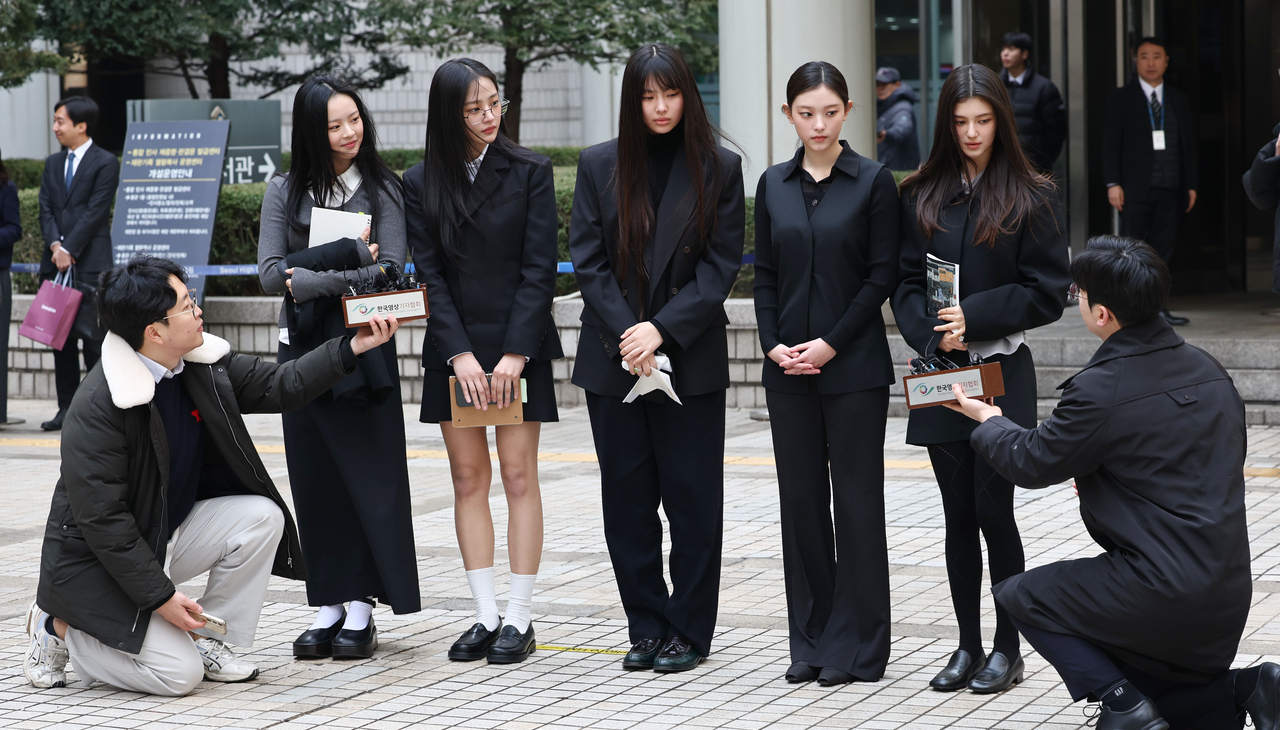
By the end of December, ADOR and Hybe announced the reformation of Newjeans as a 4-piece excluding Danielle. The online chatter was set ablaze. Danielle was clearly the ringleader, with an unnamed family member also culpable. Danielle responded by posting a live video claiming that she “fought to the very end” to be back in the group.
Her firing from Newjeans is seen by some as justice for daring to stand up to the system – a warning sign to future artists for not toeing the company line. Others view it as pure sadism by corporate overlords exploiting young artists who only dared to stand up for themselves.
When it comes to the running of the music industry and becoming part of the Kpop machine, it seems there is still much to learn. The roles of hierarchy and patriarchy are deeply ingrained in South Korea. Again, Dr Keith elaborates,
Social order is generally important in South Korean business settings, although there may be slight change among younger generations. But for the most part, employees are expected to conform to hierarchies of respect within workplaces including maintaining correct forms of address, obeying seniority, and so on. For idols in particular, who are expected to be role models for youth, it is very important to publicly adhere to hierarchies of respect.
The main vectors of this hierarchy are age and seniority (position within the company). There is also a gendered aspect to the hierarchy — South Korea has one of the world’s largest OECD gaps for gender equality, particularly in relationship roles (with women expected to do the bulk of family and household tasks) but also economic participation (i.e. the wage gap).
So, young and new female idols are really at the bottom of the respect hierarchy, which I think is part of the public fascination with the NewJeans case — that these really young women would ‘dare’ to speak up.
The powerplay that the Newjeans case highlights is not only relevant in the Kpop industry, but has parallels across the global music industry as well. From historical cases such as Aaliyah being groomed and abused as a minor, to the more recent Ke$ha and Dr Luke case, female artists are consistently taken advantage of.
Unlike those stories, which have horrific details and clearly break the law, the complicating factor for Newjeans was the legal grey area they were trying to address in both the literal court, and the court of public opinion. Their claims of workplace bullying and ostracising never really clearly crossed any boundaries in the eyes of the law, which ultimately led to them losing their case in court, explains Dr Keith.
I suspect that one of the group’s aims in this case was to garner public attention to this case (and there was already a lot of public attention on it), to sway public opinion in their favour. But while there are definitely serious concerns over mistreatment it seems that in this case HYBE’s actions didn’t cross over into a legal breach.
What I will speculate is that observers have had very different responses to the alleged mistreatment (some think it’s unacceptable, some thing that Newjeans need to ‘toughen up’). Because of the gender and power disparity here (Newjeans and Min Hee Jin being female), this inevitably intersects with some quite negative (even misogynistic) opinions I’ve seen online.
The future…
We don’t currently know, and may never truly know what truly happened behind the scenes at ADOR. As an Australian born Asian myself, who is heavily invested in following music trends, and has been listening to original hallyu wave Kpop since the 2000s, I feel personally invested in this Newjeans drama more than other scandals in the media.
When asked about the media support or coverage that Newjeans receives in Australia, (which I argue has been minimal), Dr Keith responds with the fact that other acts like Stray Kids and Blackpink are marketed as being global, whereas Newjeans are more specifically popular in South Korea who just happened to find a global fanbase.
NewJeans’ international popularity has been less calculated. For instance, I don’t often see Hanni and Danielle doing international press conferences and fronting the group as the English-speaking members. But I do see that with Blackpink and Stray Kids.
As the global wave of Kpop continues unabated, there are fears of it being diversified to the point of losing the K-ness of Kpop. This ignores the fact that the genre of pop music is founded on international (read: American) sounds and genres to begin with.
The hybridisation of K-pop has been going on for a couple of decades (foreign songwriters, foreign guest artists, etc) so I don’t think that K-pop as a whole is being diminished somehow. Rather, I see more diversity in K-pop, including these kinds of ‘crossover’ groups…I think K-pop will continue to chase these global aims but it doesn’t mean that more niche K-pop stops existing.
The collision of cultures and ideas leads to wonderful things. The vision of a truly globalist pop culture is one of the reasons I started this very blog.
However, such blends and mixes don’t come without risk. For Danielle, Hanni and resrt of the Newjeans gang (including ex-creative director Min Hin Jee), the risk didn’t quite pay off this time.
Whether Australianness was a major contributing factor in the break up or not is another question we’ll never really have an answer for. It’s just a curious question that serves as a prelude for how global culture is no doubt going to come to heads with Korean culture again in the future as Kpop continues its global domination.
There is no clear future for any party involved at the moment. All we’re left with is the fact that the era of the original Newjeans we met in 2023 may just become another one of music’s greatest ‘What ifs’…
 deadset
Leave a comment