Detroit is a city that has left an indelible mark on all forms of music history. From jazz and blues, to techno and rap, there is something truly special about America’s motor city. So when I saw a punk band named Detroit 442 on this year’s Riot Over River line-up, I knew I had to check them out.
Playing on the indoor No Masters Stage, I entered the packed out room to the familiar raucous sounds of punk energy. As I craned my neck to see the source of the screaming, I was surprised that no one was immediately within sight. Frontman Lacy Sterling had found a spot on the floor, resting on the drumkit to deliver his potent lyrics.
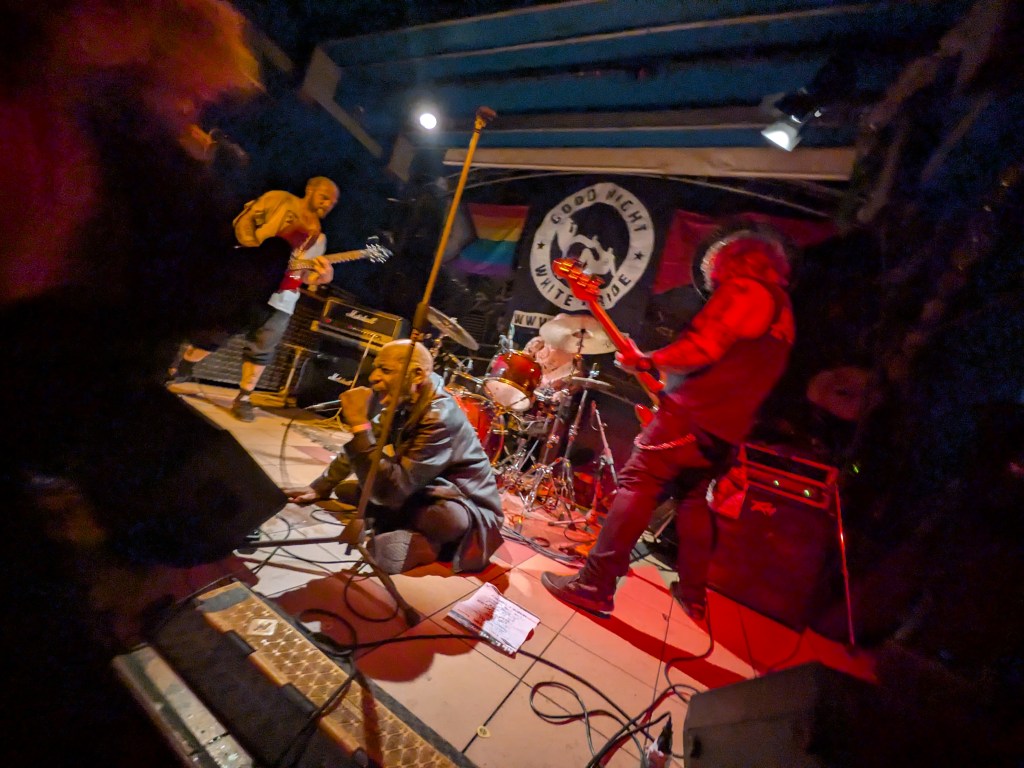
Seeing a punk frontman writhing in a sweaty heap is not unusual. But this time around, I was struck by the age of this particular gentleman. A veteran of the scene in every sense of the word, Sterling was not engaging in overdramatised physical performance. He was literally resting.
Yet there he was, screaming and delivering the politically minded lyrics of Detroit 442 with the earnestness and righteous anger of a man 40 years his junior.
“Yeah he’s been playing in punk bands since before I was born”, remarks drummer Phil Warren, “And don’t worry about him rolling into the drums either, he’s been doing that for years already.”
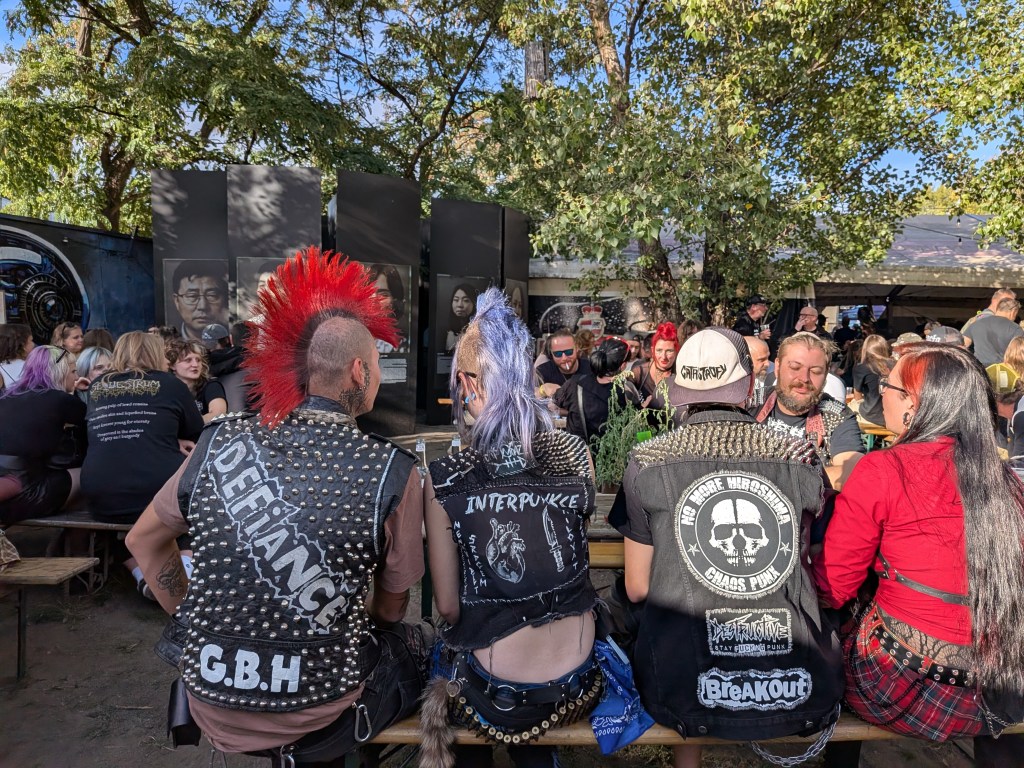
It’s not often you find a band line-up with such a huge age range. But it’s actually reflective of the punk scene as a whole. Riot Over River 2026 this year featured Scottish seminal punk act Oi Polloi as headliners, who have been playing since the 80s. Of course there were a wide array of oldheads in SHARP and Oi get-ups, but just as well-represented surprisingly, were Gen Z punks and other alternative types.
When I asked Sterling about his decades playing in the scene, and the passing of the punk torch for future generations, he commented on the extremely long path he has walked since his days as a teenager in 1970s Detroit.
“Back then, there were maybe only 3 or 4 other Black guys in Detroit or the Ann Arbor scene doing punk,” he jokes, “There was like me, Mick Collins who was in a band The Gories, and Hiawatha Bailey, who also happened to be a Black Panther, and a White Panther too.”
Of course, politics and punk music are inextricably linked. But Sterling shares that in his view, American punk as a whole is strangely apolitical.
“You have bands like Misfits or The Ramones being pushed so much as ‘punk’. But they’re not political. That’s music from the suburbs, for the suburbs. Of course there’s always going to be some element of anti-establishment in there, which is fine for those bands and their listeners, but I never knew the suburbs. I never grew up there. I came up in the city, you know? That’s why I fell in love with this other sort of punk”
He then explains their latest record as Detroit 442, the catchy titled Songs about Minneapolis, Palestine, and other fucked up shit and hands me a coaster the band distributes at their shows, featuring the following lyrics:
Those motherfuckers shot Renée Good in the head
Now someone’s wife and mother is motherfucking dead
Blood stains on the streets of Minneapolis
I wonder what the fuck we’re gonna do about thisYour moral compass has gotten you lost
In denial of the next holocaust
Politicians, they’re playing chess
Out my window I can see the distress
The reasons they are Pretti, Good
Yeah, the reasons, things are not as they should
Sterling has been playing in punk bands for almost half a century. While Detroit 442 was founded in 2006, he’s really seen the entire gamut of social and political issues in the US – from the groundbreaking effects of the civil rights movement, the oppressive Reagan era, to 9/11, the Obama years, Black Lives Matter, all the way to the current horror-comedy of errors that is the Trump administration.
It’s another reason why the band has fostered a surprisingly close connection with German and Czech audiences in recent years. Drummer Phil Warren says that these kinds of openly anti-fascist and political venues aren’t common in the US.
“You might have bars or venues that happen to have political bands playing in them. But for whatever reason, they’ll never fully brand themselves as antifascist or leftist establishments or anything like that.
Riot Over River is one of the fucking coolest festivals ever. We played here last year outside where it was hot as fuck, but this year, playing inside was so cool and raw. I love it here. [If they invite us again] Don’t threaten me with a good time!”
I never knew the suburbs. I never grew up there. THat’s why I fell in love with punk.
Lacy Sterling on how he was introduced to political punk in the 1970s
The band also booked a special performance the following evening at the intimate Cafe Na Pul Cesty. Billed as the Motor City Blues Destroyers, it was a chance for Sterling to share another important aspect of Detroit’s heritage: the blues.
However, due to a sudden line-up change, it honestly ended up being Detroit 442’s set, part 2, with some blues riffs thrown in. Which I wasn’t complaining about. (Warren jokes with me after the set, “Yeah we had no idea what we were doing up there!”)
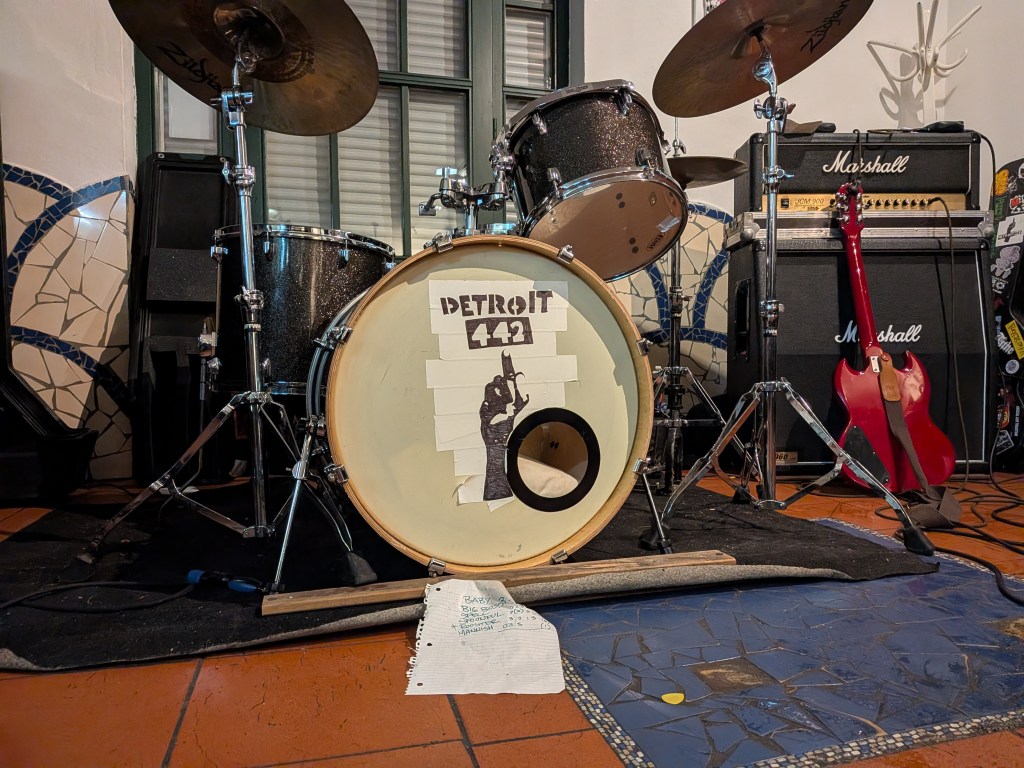
The parallels between blues and punk are hard to miss. Both come from a place of hardship and social resistance, with the blues being specific to African American history. The fact that it birthed modern American rock n roll, leading to all its permutations and combinations, including punk in the 70s and 80s, seems like history coming full circle for a band like Detroit 442. Sterling explains his early connection to blues music as stemming from his parents’ records being played around the house as providing an emotional through-line for his eventual journey into punk.
“Both blues and punk have a definite raw-ness to them that I connected with. It’s got a free edge to it. [In the blues set] I’m improvising lyrics all the time up there. I think I was yelling ‘I spell my name L-A-C-Y’ at one point or something”
(He did in fact finish the Motor City Blues Destroyers set by screaming in repetition “I’m a wild motherfucker”)
Bands like Oi Polloi, and artists like Lacy Sterling have been playing these stages for decades. It’s a true honour to speak with and hear their music and words as heroes of the genre. The legacy of their art and history weighing (sometimes literally) on their bodies and souls during performances.
Sometimes, it does feel like a bit of a time loop though – same bands, same acts, same attendees. Is there a future for punk? How does one continue making protest music, when it seems like sometimes things aren’t getting any better, and maybe even worse?
The younger Warren reflects on the Detroit scene and how mixed and cross-generational it can be.
“You’ll have the jazz cats at the punk show, and the punk kids at the blues bars, it’s really cool and tight back home. Everyone’s real supportive of one another.
Of course you’ll always have the oldheads who stick to the same places and listen to the same music, but the underground is always well and truly alive. There will always be kids who play shows and gather in venues even I’ve never heard of, you know? And I’m not even that old!”
As for Sterling, he says that he’s more than happy to see the next generation, of all backgrounds, races, gender, sexuality, take up the mantle and carry on the torch.
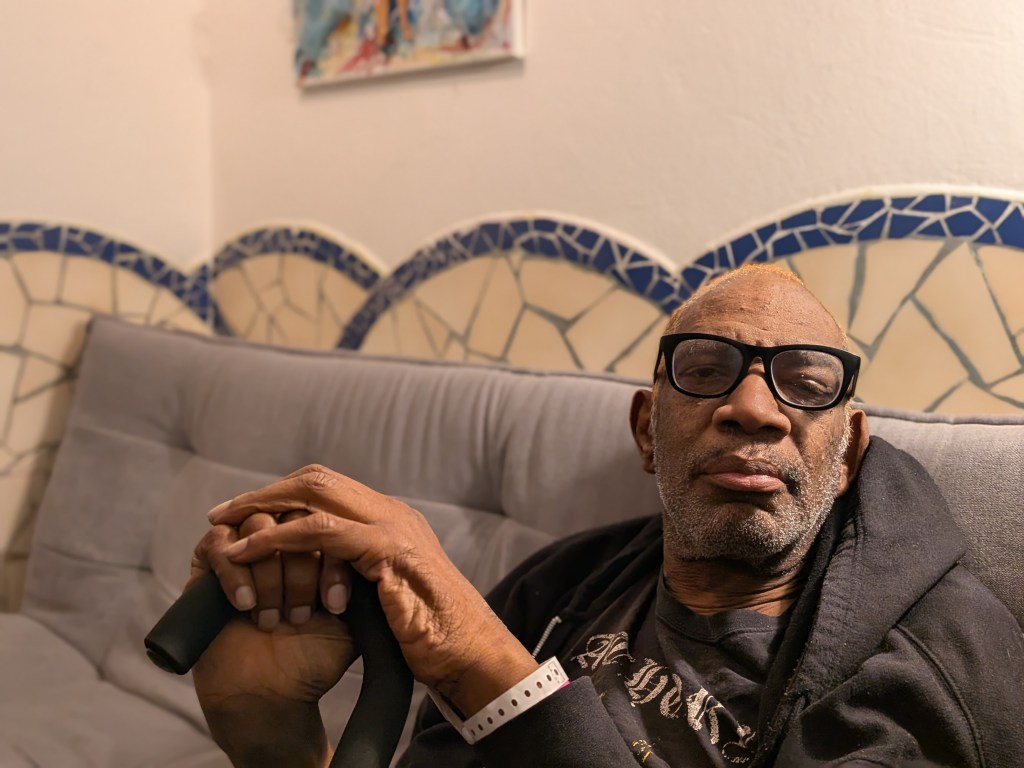
In his faded dyed orange hair, and aided by his walking stick, it’d be easy for him to say his work is done, but an artist like Lacy Sterling is living proof that age is no excuse for skipping out on resistance, music and all things punk.


Leave a comment